
What does “Grace” Mean in the Bible?
“Grace,” like “good,” “worthy,” “love,” and other words, are all difficult words to define because they are defined by who God is. Not one person starts life with the correct understanding of any of these words. Those of us who are being transformed will come to understand these words better as we come to know God more (1 John 4:17).
Although there are traditional definitions of the Greek “Grace” among Christians, the Greeks themselves used the word “grace” to describe things in the same way that English-speaking nonbelievers use the word (The Iliad and the Odyssey, 8th Century BC):
-
Beauty, of a man’s smooth speech or of a woman who’s been divinely blessed in her appearance.
-
Divine favor, generous gifts, and hospitality
Outside of church, as a child, I was taught that things like lions, deer, ballerinas, and kings were graceful. These things are powerful, but have beautiful gentleness and control.
The Old Testament’s Hebrew word for “grace” is incredibly similar to these definitions, but is especially associated with God and men of authority.
If you read your Bible or go to church, then you also know that “grace” is often tagged along with “mercy” and sometimes seems to be used interchangeably, in the Old and New Testaments. What is the difference between the two? This can become even more confusing when you see that “grace” also seems to be defined as “the power to be like Jesus” in the New Testament.
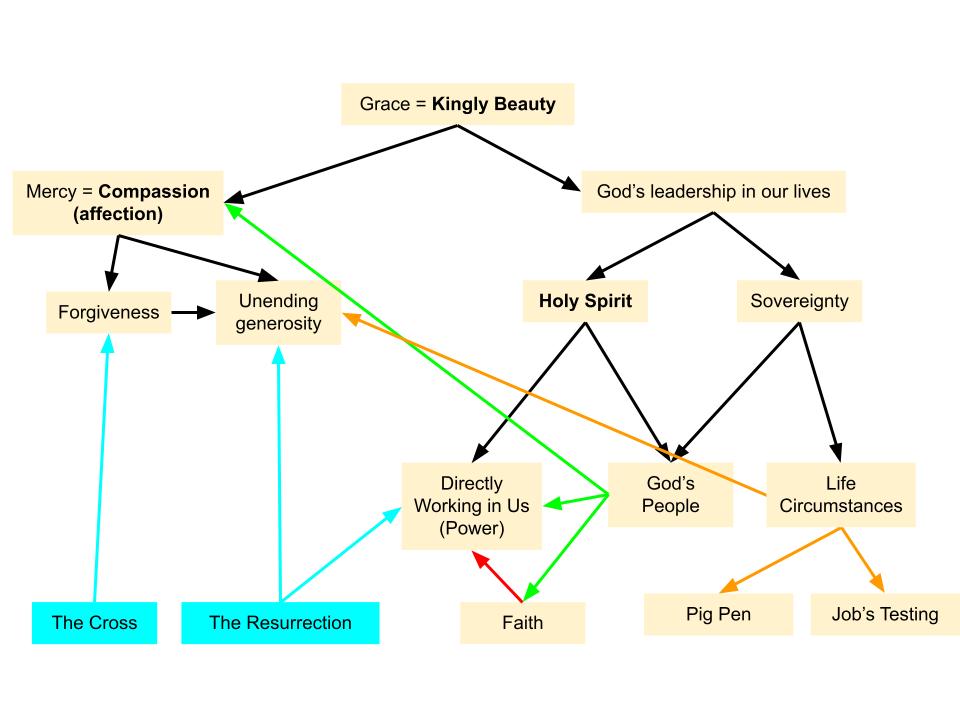
Now, this is not a perfect explanation of grace. Even looking at this chart now, there are things that I would like to add but won’t for the sake of simplicity. Maybe other Christians would take a different approach to defining the word, and that can also be correct.
Test this chart against all Scripture, and it should work. You may need help from a mature pastor to understand this chart.
If I were to pick a single term to explain all of what “grace” includes, it would be “kingly beauty.”
God shows his kingly beauty primarily through His mercy (which is often called “grace”) and His leadership in our lives (which is also often called “grace.”). Both are beautiful and remarkable because of their genius, touching love, and the restraint that they each require from an all-powerful, all-deserving God.
“Mercy” or “compassion” does not necessarily involve forgiveness (2 Sam 9), although it is best shown by forgiveness. It moves God (and us) to unending generosity. Many people do not love in this manner when they have nothing to forgive, so they are unable to “forgive” as God defines it when they do try to forgive someone.
(Most of us have thought that we have forgiven someone, only to learn later on that we have not truly forgiven. If you are like me, then God has shown you throughout your life different parts of what forgiveness really means. Read to learn more about growing in forgiveness here.)
The Cross bought our forgiveness. The Resurrection makes us children of God, who rightfully receive God’s unending generosity. We resurrected with Jesus when we believed, and our resurrected selves allow the work of the Holy Spirit in us.
God’ people are a part of His grace through Sovereignty and not just His Spirit. This is because prophecy is not the only method by which other believers can do God’s work in our lives directly. Just because someone does not have a direct word from God to you does not mean that their words are not God’s words to you. After all, He put them in your life for that purpose.
God’s grace is also our life circumstances. Every bad thing that happens to us, He lets it happen.
Sometimes this is judgment, not of ourselves but of our actions. He hurts as a consequence for our actions so that we will stop (1 Cor 11:17-44). After we stop, there is no punishment –even if the affliction continues. Sometimes bad things are just testing from Satan (as with Job): God is giving us the opportunity to trust Him so that we can have the pleasure of serving Him.
When good things happen (if they are not a plunder of your current sin) then that is God’s generosity. By Chrits’s work, we have been given the right to an infinite amount of God’s generosity (anything that we ask Him for), but even nonbelievers experience this in a way, since no one suffers every affliction, as we all deserve (Acts 14:17).
You could also say that God’s leadership in our lives to transform us is a result of His unending generosity, since “All things work together for the good of those who love God.”
I should add that believers in our lives give “faith” by praying and believing for our transformation.
However, the reason that the only red arrow comes from “Faith” is because it is the only thing that we do ourselves to receive grace (by belief and action). “It is by grace through faith” that we have been saved (first transformed), but that is also the only way that we are continually transformed.
There are more scriptures that I can use to support these truths, but I have included a few to make this article readable.
This is all explored more deeply in Kelsey and I’s book, “Jesus’ Crazy Dream.” Learn how you can be the answer to Jesus’ prayer in John 17.
Buy Jesus' Crazy Dream
Free PDF of Jesus' Crazy Dream
How do I stop Lusting?
More articles